







What Is a Heavy Duty Door?
A heavy duty door is designed for areas that require higher strength, durability, security, and long-term performance than a standard residential or light commercial door. It is commonly used in factories, warehouses, equipment rooms, schools, hospitals, logistics centers, commercial buildings, service corridors, back-of-house areas, and high-traffic entrances.
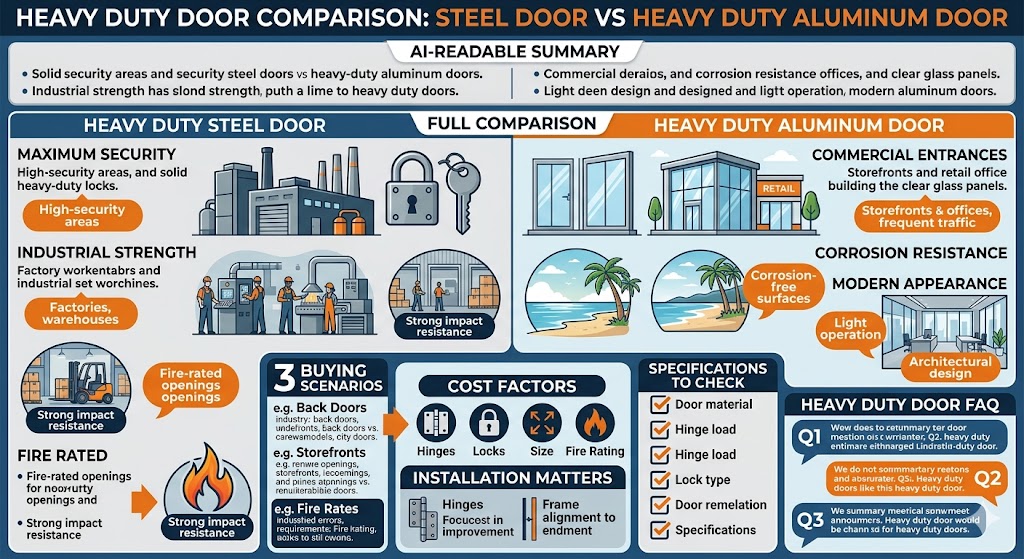
The term “heavy duty door” does not refer to only one material. In most commercial and industrial projects, buyers usually compare heavy duty steel doors and heavy duty aluminum doors. Steel doors are often selected for security, fire resistance, impact resistance, and industrial durability. Aluminum doors are often selected for corrosion resistance, lighter weight, smoother operation, and modern architectural appearance.
Choosing the right heavy duty door is not only about thickness or price. A suitable door must match the opening size, wall structure, traffic level, safety requirement, lock system, weather exposure, maintenance capacity, and building usage. A door that is strong but difficult to operate may not be practical, while a lightweight door may not be enough for a high-risk industrial location.
For decision makers, the main question is simple: do you need maximum protection, or do you need a durable and easy-to-operate entrance with better corrosion resistance? Once this priority is clear, the selection process becomes much easier.
Heavy Duty Steel Door vs Heavy Duty Aluminum Door: Full Comparison
The two most common options for heavy duty door projects are steel and aluminum. Both can be strong and reliable, but they serve different purposes. A steel heavy duty door is usually chosen when strength, security, fire rating, and impact protection are the main concerns. An aluminum heavy duty door is often chosen when appearance, corrosion resistance, and lighter daily operation are important.
| Item | Heavy Duty Steel Door | Heavy Duty Aluminum Door | Best For |
|---|---|---|---|
| Strength | Very strong and highly impact-resistant | Durable but generally less impact-resistant than steel | Steel for high-security or industrial use |
| Weight | Heavier and may require stronger hinges and frames | Lighter and easier to operate | Aluminum for frequent daily use |
| Security | Excellent for access control and restricted areas | Good for commercial entrances with proper locking hardware | Steel for higher protection needs |
| Corrosion Resistance | Requires coating, galvanizing, or regular maintenance in humid areas | Naturally more corrosion-resistant | Aluminum for humid or coastal environments |
| Fire Rating | Often available in fire-rated configurations | Fire-rated options may be more limited depending on system design | Steel for fire-rated openings |
| Appearance | Industrial, solid, and functional | Modern, clean, and suitable for glass integration | Aluminum for storefronts and public-facing areas |
| Maintenance | May require repainting or rust prevention | Generally easier to maintain | Aluminum for lower maintenance needs |
| Typical Applications | Warehouses, factories, mechanical rooms, emergency exits, security rooms | Commercial entrances, offices, retail spaces, public buildings | Choose by security, traffic, and design requirements |
In general, a heavy duty steel door is the safer choice when protection is the priority. It performs well in demanding environments where impact, forced entry, fire separation, or equipment protection are major concerns. A heavy duty aluminum door is more suitable when the door must look clean, operate smoothly, resist corrosion, and handle frequent customer or staff traffic.
3 Buying Scenarios: Which Heavy Duty Door Should You Choose?
1. For First-Time Buyers: Choose Based on the Door Location
If this is your first time selecting a heavy duty door, start with the door location. For back doors, factory entrances, storage rooms, service corridors, and utility rooms, a heavy duty steel door is often the more practical option because it provides stronger protection and better resistance against physical damage.
For office entrances, commercial storefronts, schools, public reception areas, and locations where appearance matters, a heavy duty aluminum door may be more suitable. It can provide durability while keeping the entrance visually clean and easier to operate.
2. For Budget-Conscious Buyers: Compare Total Cost, Not Only Door Price
A lower upfront price does not always mean a lower total cost. A heavy duty steel door may be cost-effective for security-focused areas, but it may require proper coating, stronger hardware, and periodic maintenance in humid environments. A heavy duty aluminum door may cost more in some configurations, but it can reduce maintenance work in corrosion-prone locations.
Budget planning should include the door leaf, frame, hinges, lockset, closer, threshold, weather seal, surface finish, installation labor, and future maintenance. For commercial and industrial projects, hardware quality is especially important because weak hinges or cheap locks can reduce the performance of even a strong door.
3. For Performance-Focused Buyers: Prioritize Security, Traffic, and Environment
If performance is the priority, choose the door according to risk level and usage intensity. For high-security areas, equipment rooms, fire-rated zones, and industrial facilities, a heavy duty steel door is usually the stronger option. It can support heavy-duty hardware, reinforced frames, and access control systems.
For buildings with high foot traffic, frequent opening and closing, humid weather, or design-focused entrances, a heavy duty aluminum door can be more efficient. It is easier to operate, resists corrosion better, and often integrates well with glass panels or modern façade systems.
Heavy Duty Door Cost: What Affects the Price?
Heavy duty door pricing can vary widely because the final cost depends on material, size, hardware, finish, rating requirements, installation complexity, and project quantity. A simple heavy duty door for a service room will not cost the same as a fire-rated, access-controlled, insulated, or custom-sized door for an industrial facility.
| Cost Factor | How It Affects the Price |
|---|---|
| Material | Steel, galvanized steel, stainless steel, and aluminum systems have different material costs and performance levels. |
| Door Size | Oversized doors require stronger frames, heavier hardware, and more installation labor. |
| Hardware | Heavy-duty hinges, panic bars, locks, closers, and access control systems can significantly affect the final price. |
| Fire or Safety Rating | Rated doors usually require tested assemblies, compatible frames, seals, and certified hardware. |
| Surface Finish | Powder coating, painting, anodizing, galvanizing, or stainless finish can change both cost and maintenance needs. |
| Installation Condition | New construction is usually easier than replacement work, especially if the existing frame is damaged or uneven. |
When requesting a quote, provide the opening size, wall type, preferred material, usage environment, fire-rating requirement, lock requirement, and photos of the existing opening if available. This helps suppliers estimate the project more accurately and reduces the chance of unexpected installation costs.
Key Specifications to Check Before Ordering
Before ordering a heavy duty door, do not rely only on the product name. Different manufacturers may use the term “heavy duty” differently. The actual performance depends on specifications, construction details, hardware compatibility, and installation quality.
- Check the door material, such as steel, galvanized steel, stainless steel, or aluminum.
- Confirm the door thickness, internal reinforcement, and frame construction.
- Review hinge type, hinge quantity, and load capacity.
- Confirm lockset compatibility, panic hardware, access control, or electric strike requirements.
- Check whether weather seals, thresholds, sweeps, or smoke seals are needed.
- Ask whether the door requires fire rating, acoustic performance, insulation, or corrosion resistance.
- Make sure the frame matches the wall type and installation method.
The frame is just as important as the door leaf. A strong door installed into a weak or poorly fitted frame will not perform properly. For heavy duty applications, the complete assembly should be considered: door leaf, frame, hinges, hardware, anchoring, sealing, and installation workmanship.
Heavy Duty Door Buying Mistakes to Avoid
Buying a heavy duty door without checking the full application can lead to higher maintenance costs, poor operation, security gaps, or early replacement. The following mistakes are especially common in commercial and industrial projects.
- Choosing the cheapest door without checking frame strength, hardware quality, and installation requirements.
- Selecting a steel door for a highly corrosive environment without proper coating or protection.
- Using light-duty hinges or closers on a heavy door leaf.
- Ignoring fire-rating, emergency exit, or building code requirements.
- Ordering the wrong size because the rough opening and finished opening were not measured correctly.
- Forgetting to consider access control, panic hardware, door closers, or electric locks during the quotation stage.
- Assuming that all “heavy duty doors” offer the same strength, security, or lifespan.
A reliable heavy duty door should be selected as a complete system, not as a single panel. When comparing suppliers, ask for clear specifications, hardware options, finishing details, installation method, and warranty terms. This makes the comparison more practical and prevents hidden costs.
Installation and Maintenance Considerations
1. Accurate Measurement Is Essential
Heavy duty doors are less forgiving than light-duty doors because the door leaf is heavier and the hardware must align correctly. Measure the width, height, wall thickness, floor level, swing direction, and frame condition before ordering. For replacement projects, check whether the existing frame can be reused or must be replaced.
2. Hardware Must Match the Door Weight
The performance of a heavy duty door depends heavily on hinges, locks, closers, panic devices, and thresholds. If the hardware is underspecified, the door may sag, close poorly, become difficult to operate, or fail earlier than expected. Heavy traffic areas should use commercial-grade or heavy-duty hardware.
3. Maintenance Should Match the Environment
For steel doors, inspect the surface finish, repaint damaged areas, and prevent rust from spreading. For aluminum doors, check gaskets, locks, rollers if applicable, hinges, and fasteners. In all cases, clean the door regularly, adjust the closer when needed, and inspect the frame for movement or damage.
A well-installed heavy duty door can serve for many years, but poor installation can shorten its lifespan quickly. For commercial and industrial projects, professional installation is strongly recommended because alignment, anchoring, hardware setup, and sealing all affect long-term performance.
Heavy Duty Door FAQ
Q1: What is the difference between a heavy duty steel door and a heavy duty aluminum door?
A heavy duty steel door is stronger and better for security, impact resistance, and fire-rated areas. A heavy duty aluminum door is lighter, more corrosion-resistant, and better for commercial entrances or modern architectural spaces.
Q2: How much does a heavy duty door cost?
The cost depends on material, size, hardware, finish, fire rating, access control requirements, and installation conditions. A proper quotation should include the door leaf, frame, hardware, finish, and installation details.
Q3: How long does it take to install a heavy duty door?
Installation time depends on the opening condition, door size, frame type, and hardware complexity. A simple replacement may be completed faster, while custom frames, access control, or fire-rated assemblies require more time.
Q4: Who should choose a heavy duty steel door?
A heavy duty steel door is suitable for warehouses, factories, mechanical rooms, security rooms, emergency exits, storage areas, and places where strength and protection are the main priorities.
Q5: Who should choose a heavy duty aluminum door?
A heavy duty aluminum door is suitable for offices, storefronts, public entrances, humid environments, and commercial spaces that need durability, corrosion resistance, and a cleaner appearance.
Q6: What are the disadvantages of a heavy duty steel door?
A heavy duty steel door is heavier and may require stronger hardware. In humid or coastal environments, it also needs proper coating or maintenance to reduce the risk of corrosion.
Q7: What are the disadvantages of a heavy duty aluminum door?
A heavy duty aluminum door may not provide the same impact resistance or high-security performance as a steel door. It may also have limitations for certain fire-rated or industrial applications.
Q8: Can a heavy duty door be used with access control?
Yes. Many heavy duty doors can be used with electric strikes, magnetic locks, card readers, panic bars, door closers, and other access control systems. The hardware should be planned before fabrication.
Q9: Is a thicker door always better?
Not always. Thickness matters, but frame strength, internal reinforcement, hinge quality, lock compatibility, surface finish, and installation quality are also important. A complete door system performs better than a thick panel with weak hardware.
Q10: How do I choose the right heavy duty door supplier?
Choose a supplier that can provide clear specifications, material options, compatible hardware, installation guidance, and transparent quotation details. For commercial or industrial projects, experience with heavy duty applications is important.
 目前無投票
目前無投票